A Day in the Life of Big Fat Alpaca

Psst…want a behind the scenes look at how yarn is made at a mini-mill? Come on, follow me! Mette of Ranch of the Oaks was kind enough to take many of these pictures during several steps of the process.

First, the fiber is washed in a special non-agitating machine, then set on a mesh rack to dry. I don’t have any pictures of this because it would be rather like….watching fiber dry.

The first fun step is going through the picker. This machine picks apart the fibers, opens up the locks, and fluffs it up. Locks go in, fluff comes out!

Dec2011Download 077

Conditioning oil is then sprayed on the fiber – I know, weird right? You just washed it and now you’re spraying oil on it? This helps keep the static down, and keeps the fiber from sticking to the machines during the rest of the process. Then chunks of fiber (see how much fluffier they are?) are sent to the fiber separator.

Dec2011Download 081

This machine gets out more vegetable matter – oh how those alpacas love to roll and get dirty! – as well as shorts and second-cuts for shearing. It can also be used to dehair and separate downy undercoats from coarser outer coats of other fleeces such as pygora, but requires many passes. Typically, a run will go through the fiber separator twice. Unless you’ve bought fleece that is riddled with vm…ask me how I know! I’m much pickier about my alpaca fleece nowadays. It wasn’t easy, but I now have the willpower to refuse the softest fleece if it’s chock full of hay and stickers. :) Anyway, this is the waterfall of fiber that comes out of the fiber separator.

Dec2011Download 082

The next step is the carder, these are pix I took from a different alpaca run. The carder brushes the fiber and funnels it into a strip of roving. Consistency is important at this step – the more consistent the roving produced, the more consistent the finished yarn will be. The carder operates at a constant rate, so the thickness of the roving at the output is completely dependent upon how much fiber you feed into it. You’ll notice the blue stripes on the conveyor – these are marked so the operator can spread out a consistent weight of fiber between each stripe. To make roving for a bulky yarn, 3 oz of fiber might be laid down at a time. For a lace yarn, 1 oz of fiber might be laid down.

IMG_0109

The carder consists of one large central drum, surrounded by 6 pairs of carding rollers. The large central drum really just conveys the fiber from roller pair to roller pair – the pair do the actual carding. You might think that the carders align the fibers, but they don’t. They really just separate them and create a consistenty fluffy sheet. The fiber orientation is still pretty random in this sheet – meaning some are parallel, some are perpendicular, and many are at all sorts of angles and orientations in between. Here’s the roving coming out of the carder:

IMG_0111

Do you see where I’m going with this? Because the fibers aren’t aligned, lots of air is trapped in the roving. This is considered a woolen preparation. Most yarn that is mass produced, that you buy in your local yarn store, is spun from a worsted preparation. It goes through a commercial combing process – different machines with different actions prepare the fiber so that each one is parallel to the next, any fibers of inconsistent length are removed, and the resultant top (not roving! Roving = carded prep!) also goes through a straightening and steaming process during which much of the crimp is flattened out. This type of prep is done so that the spinning is as consistent as possible, and it makes a very compact and durable yarn.

Are you starting to see some of the differences? Neither is right or wrong or good or bad, they’re just different! There are many different ways to make yarn, and it’s great to explore them all! If that’s even possible, but I’m working on it. :) Anyway, yarn made from a woolen prep (that’s the carding process that I’ve photographed above) is going to be lofty, airy, but is going to be a little more variable in texture and thickness. It’s also going to retain a lot of the characteristics of the original fiber – since the roving isn’t straightened or steamed before it’s spun, the resulting yarn is pretty lively. Yarn made on a large scale from a worsted prep (the combing & the steaming) is very consistent, and tends to be more compact.

Have your eyes glazed over yet? Or are you salivating and considering buying a spinning wheel so that you can experience all of this fiber wonderfulness for yourself? Enabler, me? Never. Anyway, MORE PICTURES!

A hand-spinner could take roving straight from the carder and spin it forever in eternal bliss. But unfortunately, machines aren’t as good as a hand-spinner. Your hands will automatically adjust if the roving is slightly thicker or thinner, and will create a pretty consistent yarn no matter what. A machine can’t tell the difference, so we have to feed it the most consistent roving we can. One way of making roving more consistent is combining it with another strand of roving – the thick and thin spots of one tend to even out the thin and thick spots of the other, and the result is more even. It’s combined at the draw frame – each roving is drafted a little separately, fed together, then drafted a little more together. Below you can see 2 sets of 2 strands of roving going into the drawframe.

Dec2011Download 089

Here (different run) you can see the 2 sets coming out of the drawframe as single rovings.

IMG_0101

Now, since we’re further aligning the fibers in this step, we start to leave the realm of a fully woolen preparation. The fiber orientation is still quite random, but not as random as it was before. I don’t think that it’s wrong to still call it a woolen prep, as it’s just a smidge off (and there’s endless debate over the precise definition of these words – some feel that the only true woolen prep is a hand-carded rolag). But you can call it a semi-woolen prep if you like. Clear as mud, right?

And finally, the spinner! These pics are from a day that Mette was spinning quite a large batch – all 8 spinning heads were going at once. From the back, roving goes in:

IMG_0098

And at the front, yarn comes out!

IMG_0093

For my Big Fat Alpaca run, she only had 2 spindles going at once:

Dec2011Download 090

Now, to further blur lines between woolen and worsted, this yarn is essentially spun short-draw – there is no twist in the zone between the drafting rollers. So a woolen prep, spun with a worsted technique….semi-worsted yarn! No, semi-woolen! No, woolsted! No, worsten! I have an idea – LET’S JUST CALL IT AWESOME.

Now, we have bobbins of freshly spun singles. Let’s ply! The two singles are twisted together in the opposite direction at another machine, which only plies.

Dec2011Download 091

A close-up of the actual business:

Dec2011Download 092

The result:

Dec2011Download 093

And steaming! Which I had to take a quick video of to show you the whole shebang.  This evens out and relaxes excess twist energy.

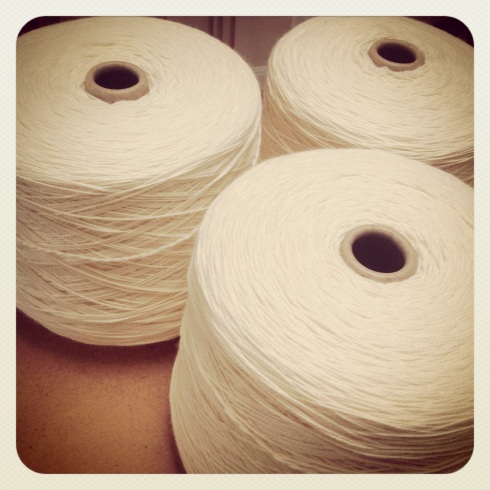
Leaving you with….ta-da! A cone of beautiful yarn.

Dec2011Download 111

You might think we’re done there. Well, Mette is, but I’m not. I then take the cone of yarn, wind it into skeins, tie it up tidily, and wash it. Why wash it? The cone is wound under tension, so the yarn will be a little stretched out when first skeined. Washing it relieves that tension, and makes is sproing back up again. Plus, remember when we added conditioning oil in one of the first steps? That’s still in the yarn. The yarn is also a little dirty – even though the first step was washing the fleece, the fiber has been picked, separated, carded, and fluffed many times, all which helps loosen up dirt that was initially trapped in those locks.

So I wash, dry, hang in the sunshine, label, and presto!

Yarn, ready for whatever you have in mind.


I should be…

  • Taking photos of yarn
  • Updating my website
  • Endlessly tweaking my website to make it better
  • Updating my yarns on Rav
  • Updating my projects on Rav
  • Figuring out sales tax for last quarter
  • Sending out a freakin’ newsletter since it’s been…what? Yeah, you probably didn’t know I even have a newsletter. Me neither.
  • What I am doing:

  • About to graft together the hood on my Vivian
  • Watching interviews with Lady Gaga on the internet.
  • Vivian Hood (Medium)

    Hey, don’t judge me on that last one – I blame my fitness teacher Michele for getting “Bad Romance” massively earwormed into my brain yesterday while doing a bazillion squats. Actually, to be totally honest, I think Lady Gaga is pretty damned talented. And I do like her Honeybadger doesn’t give a shit attitude.

    That said – GRUNGE 4EVER!!! I’m going to see the Foo Fighters tomorrow at the Forum in LA and couldn’t be more excited about it. I’ve been listening to their new album and watching videos on YouTube for a few days now. They are so goofy and awesome, I love you, Dave Grohl. LOVE YOU.

    Anywhoo – knitting, what? Well, since the weather started to turn chilly (until a heatwave decided to roll through – supposed to be 96 today, WTF?), I took my Vivian out of hibernation. (Which is being knit out of the blue yarn pictured in the blog header.) I set it aside for a few months since A) It was too darned warm to contemplate serious wool sweater knitting, and B) Once I completed the shoulders, I felt the waist was too high. So I busted it out again, tried it on again, took it to a few of my knitting groups, and got some opinions. All of which were along the lines of: “It looks great, WTF are you talking about?” And now that’s it’s sat for a while, it looks less short to me too. And it feels pretty nice when I have it on. So I decided to stop being such a stupidly picky perfectionist and just finish the damned thing already. I knit the remaining few rows of the hood last night, and now all I have to do is graft it together and install the zipper. Those are 2 huge things – the grafting is in cables & seed stitch, and I’ve never put in a zipper before – but I’m gonna power through them. Maybe even be done by the end of this weekend!

    There was another impetus for me to pick up the sweater again, which was reading Yarnagogo’s book A Life in Stitches. I was recently up in Oregon for OFFF, and hung out for a few days after to visit some friends. One of them told me that I had to go to Powell’s Books, and boy, was she right. It’s giant, a full city block, and it has its own map and information desks sprinkled throughout. I walked in, and was looking up with big wide eyes at the sign with all the subjects and their locations, when a nice voice asked, “Can I help you find something?” I turned around to the woman at the information desk and said, “Um, I don’t know. It’s my first time here. Maybe textiles?” She pulled out a map and gave me the quick overview, pointed out the textiles section (just through sci-fi, perfect!), and I noticed she had a knitting book in front of her. I excitedly asked, “Do you knit?” At which point she actually looked a little embarrassed and said, “Yeah, I knit.” I gave her a smile and said, “Me too, I actually have a business hand-dyeing yarn.” But she still looked a little uncomfortable, which seemed odd and made me uncomfortable, and so I didn’t bust out a business card and instead headed towards sci-fi and the coffee shop.

    Far from being giant and overwhelming with largeness and fluorescent lighting, like you might expect for a giant bookstore that takes up an entire city block, Powell’s is cozy and intimate. There are several floors and rooms, each one having a different subject. So I wandered through the sci-fi room and felt like I was in my own little geeky heaven. I went to the textiles section and found some awesome old books and pamphlets on natural dyeing. The other great thing about Powell’s is that used books are mixed right in with new ones, so all available knowledge on a subject is in ONE place. Brilliant!

    Anyway, I was wandering around with a 10-mile stare (have you ever seen people at the Stitches West Marketplace for the first time? Kind of like that!), just reveling in the fact that I was in a giant repository of human knowledge on just about every subject imaginable. And then, as I was scanning through the spinning books, I saw Abby’s Respect the Spindle. And I thought “Man, how cool is that. Someone I know has added to this great repository, has made a meaningful contribution to the sum total of human knowledge, and other people can come here and read and learn from her.” It almost made me want to buy the book again. And then I saw the latest issue of Spin-Off and thought about Jacey and her new book coming out. And then I thought “Hey! I haven’t read Rachael’s latest book!” Yes! Something I can buy from a person that I know! But wait – would that be in autobiographies or knitting or ??? So I went to the nearest info desk and the clerk looked it up for me. “I like the title,” he said. Yeah, me too. He directed me back to knitting, scan, scan, scan, scan – there! And I picked up a shiny new book, written by someone I’ve actually met and hung out with, and took it to the checkout counter with a silly grin on my face.

    It’s hard to articulate why that was such a neat experience. First, there was Powell’s. Instead of being some giant warehouse where everything looked the same, I instantly felt at home and like this huge place was my bookstore. Then I had the personal connection of knowing a few authors, which made purchasing something truly enjoyable. I was happy to be giving my money to a cool place, and know that a person I cared about was going to benefit from my small action. And at the same time, it was like a big FU in the face of giant chains and corporate branding and the growing homogeneity of our culture. My experience was actually personally relevant, suck on that Borders and Barnes & Noble! And there was also a smaller, and perhaps futile FU to the concept that books are obsolete. I’m a big technology whore, and I love that Kindles and iPads and tablet computers exist, but there’s nothing like browsing through an actual store and holding a physical book in your hands. Smelling the (probably toxic) page fumes. It’s just magical.

    Ahem. Where the hell was I? Inspired to knit sweaters, right! Well, in Rachel’s book, she talks about what was happening in her life at the time she was knitting certain things, and how those are intertwined. What I got out of all this was Damn, that girl has knit a lot of sweaters. Sweater knitting apparently is not a big deal for her. And then this giant lightbulb went off and I thought, “Shit, sweater knitting doesn’t have to be a big deal for me either. I’m the one who makes it a big deal just by thinking it’s a big deal, and you know what? I can control my own damned thoughts!!!

    So you heard it here first, folks. Sweater knitting – no big deal. I have a crapton of yarn, I know how to freakin’ knit, all I have to do is do it. So I’ve actually been using Ravelry to – gasp! – look up patterns lately, instead of drama. :) After all, Winter Is Coming.


    Never Not Knitting Podcast, Episode 56!

    Hey, all! I’m featured in the latest episode of the:

    NNK Podcast Logo

    Podcast, #56! I was thrilled when Alana asked me to be a sponsor, and it’s just plain awesome to be able to share the story of my Small Farm Yarn with everyone.

    There’s even a giveaway of an Alpenglow Yarn sampler – enter a comment on her blog here for a chance to win! And let me just say, the comments have totally made my year. I have read each and every one of them (and continue to check and read the new ones!), and I’m incredibly touched and a bit overwhelmed by all the excited and glowing responses. It’s simply amazing and wonderful to have that kind of feedback, and I wish every comment had a love (1) button because I would click them all.

    If you’re checking out this blog because of the podcast, you can follow Alpenglow Yarn in a few ways:
    Friends of Alpenglow Yarn group on Ravelry
    curlie or Alpenglow on Ravelry
    Alpenglow Yarn on Facebook
    Newsletter signup (I don’t send out many of these, I promise!)

    Thank you all so much!
    {{HUGS!}}
    -Carrie


    Home-grown Weld

    Funny story. So I’m growing weld for the first time, which is a dye plant that gives the most light fast yellow known. It shot up stalks and was taller than me, the little yellow flowers were starting to open. I wondered when the heck I should pick it, so I did what anyone with a computer does – I Googled it. And I became a bit confused by all of the hits for marijuana cultivation on the first page of results. (Get it? Hits? Ba-dump-chhhh!) At which point I notice the one-liner below the search box:

    Showing results for when to harvest weed. Search instead for when to harvest weld.

    Um, yes, please search instead…..

    Anyway, opinions seemed to vary on when to harvest weld (imagine that), and I also heard from another dyer that plants in crappy soil that only grew to about 2 feet tall yielded the best dye, and larger plants were likely to be quite weak. Hmmm. My plants were a bit over 2 feet tall….these are the couple I left after harvesting 4 more just like them:

    I cut off the flowers, put them in a paper bag, and hung the stalks upside-down in a dark place to dry. I left them for about 2 weeks. The flowers were already separated, I further separated the leaves, the remaining small stalks, and the large main stalks. Time for a test! Here’s the relevant data:

  • Yarn was superwash merino
  • Mordant was alum
  • Weld used at 50% WOG
  • For those not familiar with natural dyeing terms, WOG is “Weight Of Goods”. In other words, the amount of weld used was 50% the weight of the yarn dyed, or 50g of weld per 100g of yarn. My 5 batches were:

  • European dried weld, what I normally purchase and use
  • IMG_6593

  • Home-grown weld large stalks (not pictured)
  • Home-grown weld small stalks
  • IMG_6592

  • Home-grown weld leaves
  • IMG_6594

  • Home-grown weld flowers
  • IMG_6595

    And the extraction & dyeing process I used:

  • Soak weld in water overnight
  • Soak test skeins in water overnight
  • Put weld and water in a stainless steel pot, bring to boil
  • Boil for 30 mins
  • Strain out weld
  • Add wet test skein to hot dyebath, leave to dye/cool overnight
  • Normally I’d be more conservative about adding cold yarn to hot water – with minimally processed wools, it’s a recipe for harshness, if not outright felting. But these were small test skeins, superwash wool, and I didn’t want to spend a lot of effort on cooling the dyebath, since I was also dyeing production batches at the time. So I didn’t really care if they lost a little hand.

    And the results!

    IMG_6606 (Large)

    IMG_6601 (Large)

    Going from most saturated (left) to least saturated (right) in both shots above:

  • Home-grown flowers
  • Home-grown small stalks
  • European dried weld
  • Home-grown leaves
  • Home-grown large stalks
  • So…I have to say I’m pretty stoked. I got what I’d consider really good color from my first crop! The flowers and small stems were definitely worthwhile, and the leaves were about on par with the European dried weld I had. The large stalks aren’t really worth the effort, I’d say they have about equivalent color to a typical exhaust bath.

    As far as when they were harvested…well, they had been flowering for the better part of a month, and the flowers near the tops of each head were just opening. Plants were about 5 feet tall, and as you can see in the very first pic, had one main stalk with many sub-stalks and flower heads. Another very interesting thing is that all of these plants are less than a year old. This is a little strange – weld is supposed to only form basal rosettes the first year, like so:

    Weld rosettes (Large)

    I planted these in July of last year, so I guess you could argue that it’s the second growing season and they’ve seen one “winter”. But, I planted more seeds in early April of this year, and a few of them are now stalking in their first season:

    Weld small stalk (Large)

    San Luis Obispo does go hot/cold a lot in the spring and fall. It’s not unusual to have a week of 85-90 degree weather followed by a week of 60 degree weather. So I think the temperature swings faked them out into thinking they had seen a “winter”. Speaking of “winter” – it does dip below freezing at night, but a high in the 50s would be a pretty cold day. I shut off the sprinklers between November and February this past year, and the weld rosettes were overgrown by coreopsis and marigolds. So I pretty well neglected them for about 4 months and they survived and dyed splendidly.

    The moral to this story – JUST GROW IT! Seriously, you have nothing to lose and weld is spendy stuff, so there’s a lot to gain. As you can see from these last 2 pictures, I’m planting it in whatever space I can around the house and it seems to be doing well.

    Where you can buy weld seeds:
    Thyme Garden Herbs
    Sand Mountain Herbs
    Alchemy Works
    Earth Arts
    The Woolery
    Horizon Herbs doesn’t carry weld, but carries a lot of other seeds and even madder seedlings in season.

    Do note that the proper name for weld is Reseda Luteola. The main dye compound is luteolin, which is the most light fast natural yellow. There is also a species of plant called Reseda Lutea, but this is not true weld and contains zero to very small quantities of luteolin (Cardon, Natural Dyes, pg 171). So make sure you get the right stuff!

    Happy growing!


    The Dye Garden

    I’m so excited – I have seedlings! They’re so fragile and green, I check on them every morning over a cup of coffee. Warmer days are finally here, and these 3 madder starter plants I got from Horizon Herbs are really taking off.

    Madder seedlings (Large)

    And I have a few that I started from seed just breaking though the ground!

    Madder Seedling 2 (Large)

    I’m a long way from growing enough of my own dyes to actually make an impact on my dyeing, but it’s fun and really rewarding to grow a few plants. I’m learning a lot and who knows? Maybe someday if I have access to enough land, I could have a dyeplant operation and grow enough to supply multiple dyers. It is incredibly difficult to get natural dyes, and they are very expensive. How cool would it be to having a dyefarm operating in the US where you could buy madder, weld, indigo, and a host of other plants….

    Ok, back to the current reality. Check out my weld from last year! I seriously did not water this at all over the winter, ignored it for months as it was overtaken by marigold and coreopsis, and look at it now:

    Weld2 (Large)

    I cannot wait to harvest the stalks later this year! I also planted some indigo, which I think is coming up….but since I’ve never grown indigo before, I’m not entirely sure what’s a weed, what’s a volunteer, and what’s an indigo seedling. :)

    My marigold seedlings are doing well, these are African marigolds. I have French in another planter.

    Marigold Seedlings (Large)

    And I have a few Hopi Sunflowers poking up! I love how some sunflowers are still wiggling out of their seed shells when they break the surface:

    Hopi Sunflower Seedling (Large)

    Apparently these make a purpley-black dye. The seeds are striking different from “normal” sunflower seeds – they’re solid black. The flower heads are big and yellow as usual, though. I have some seeds from last year that I need to test out soon! And since most of my big mundane chores are finally wrapping up (taxes and a massive post-Stitches update of the website), I think I’ll finally be getting back to pots!

    I’m planning to vend at more fiber festivals this year, yay! Here’s a current list of events:

    June 4th – Spinning at the Winery – Retzlaff Winery, Livermore, CA. I had a really cool conversation with Will Taylor a few days ago about the event. I hadn’t realized how strongly focused it is on local and American-made yarn, they specifically do not want to see any yarn made in China, Australia, or abroad. So I’m leaving the Global Yarn at home (yes, that does mean no superwash sock, though in other news, a superwash facility is finally coming online in the US), and bringing lots of fiber, Small Farm Yarn, and American Yarn! I’m hoping to get all of my natural-colored alpaca from the Central Coast swatched and labeled by then.

    July 10th – Oakland Fiber Festival – Splash Pad Park, Oakland, CA. This will be a day of fun at the park with a bunch of vendors! There’s a Rav group here . It’s always fun to head to the big city, and exciting to have a fiber event that’s reasonably close to home. I’ll have my whole line-up of yarn there!

    October 1st – CogKnitive Fiber Retreat – Tehachapi, CA. This was my first vending event last year, and I’m looking forward to celebrating an Alpenglow Anniversary with Dr. Gemma, Nathan, the Knitmore Girls, and the CogKnitive crew!

    That’s all for now, though I have an application out to OFFF, so cross your fingers for me on that one! I’m also hoping to vend at the Southern California Handweavers Guild show in Torrance in November. And even though I won’t be there, some of my yarn will be at Sock Summit with the fabulous Didi of Little Red Bicycle!

    I’m a little bummed that I didn’t get into Black Sheep as a vendor – 15th on the waiting list – but hopefully next year. And I’ll be going as a participant this year since I’ve never been! So it’ll be pretty darned fun anyway – road trip with friends, camping, partying with ColorBomber Velma at her Pie & Beer shindig, trying to not buy Any.More.Fiber(!!!)….good times for sure!


    Dyeing to get to Stitches!

    Sorry, bad pun, I know. I couldn’t help it – I’m so excited because some of my best yarn yet just came out of the dyepots. There’s a magical quality to dyeing – certainly I have a good idea of what color the yarn is while I’m dyeing, but it’s not until it’s almost dry that the final shade and nuance is revealed. Sometimes it takes on an entirely new life when I pull it out of the washing machine, and today was one of those “Holy SHIT!” days when I surprised even myself.

    This is my best, most interesting batch yet:
    SMerF Moss (Medium)

    This is one of my brightest colors, the neon quality was unexpected but completely welcome:
    Lofty Corrie Fingering green (Medium)

    More bright red, perhaps my favorite color to dye:
    Corrie Sport Ephemar (Medium)

    A great cotton/wool blend that takes the dye in a heathered kind of way. Very interesting to the eye.
    Bollistic Tweed green (Medium)

    Now that I’m pretty much done dyeing (there’s some slight tweaking going on the background, but not much), I’ve actually relaxed and destressed a bit. We have our booth figured out, got the fixtures and furniture, all that’s left is reskeining, labeling, and making signs. Which are all big tasks, but more chill than living my life in 30 minute increments, keeping track of 6 dyepots, loads of yarn in the wash, and boiling dyestuffs.

    I just can’t wait to put everything out there, meet new people, and talk about yarn. It’s the best part of the whole business. Plus the party line-up for Stitches is going to be pretty awesome. Ravelry Happy Hour on Thursday night and LSG Hoariversary on Saturday. Woo!


    Ta-Na-Na-Ah, Ta-Na-Na-Ah, Stitches, Stitches, He-e-llo

    Lambie says: Stitches is in just a month! Get on it, yo!

    Lamb Talking 2 (Medium)

    I just got back from TNNA, so I’m full of energy and inspiration! It was great to visit with a few of my yarn suppliers, put more faces to names, and see good friends. I also spoke with several smaller US mills and hope to have a new American yarn base or two in the late spring. Good stuff!

    So have I mentioned that I’ll be vending at Stitches West this year? It’s my first time, it’s both exciting and terrifying. Myself and Ranch of the Oaks are splitting a booth – 1048, be sure to drop by! Mette will have lots of natural colors of her own alpaca yarn, plus Icelandic wool, plus llama yarn, plus blends of everything. I’ll be bringing lots and lots of naturally-dyed yarn, about 1/3rd of it will be Corriedale from the Ranch and Central Coast alpaca. And we’ll both have lots of fiber for spinning! And have I mentioned the 15 micron merino that I brought back from Australia? Mmmmmmm…. And! If that wasn’t enough…I’ll also have some Little Red Bicycle yarns! Yay! Hopefully her laceweight order will come in and I’ll have some beautiful hand-dyed skinny stuff, but I’m certain to have sock yarn at the very least. Woot!

    There are going to be several natural dyers at Stitches this year – I definitely encourage everyone to check us all out, as we all have different twists on colors and fibers. As far as I know, the following will be there: A Verb for Keeping Warm, Tactile, Pico Accuardi Dyeworks, and Carolina Homespun usually carries Nature’s Palette yarn.

    What else is noteworthy? Two of my yarn suppliers will be there – Green Mountain Spinnery and NordicMart. Green Mountain Spinnery is located in Vermont, they make wonderful yarns out of American wool and US-made Tencel. Several of my American Yarns are theirs. And a few of my Global Yarns are from Garnstudio – NordicMart is based here in San Luis Obispo and carries their complete line. Ball and Skein and More in Cambria will also be at Stitches for the first time, and they’ll be highlighting O-Wool yarn, which I also use for dyeing. Michelle Miller of Fickleknitter Design will also have a booth – she creates great patterns, many of which are small yardage and perfect for hand-dyed yarns. I’ll also be a selling a few kits of: one of her patterns, yarn to go with it, and a handmade project bag!

    I think that covers my shout-outs for now. Stitches can be pretty overwhelming, so it’s sometimes handy to have recommendations, especially for us new companies that no one has ever heard of. Oh, I have one more shout-out for very interesting stuff – don’t miss John Marshall’s booth. Last year he had very interesting gold yarn (yes, real gold over silk), he sells really cool fabrics, and also very good and user-friendly instant indigo (though I don’t know if he’ll be bringing that to Stitches).

    And don’t forget my booth, okay? :) 1048!


    Follow

    Get every new post delivered to your Inbox.

    %d bloggers like this: